The Saga
The Guild, The Collapse, and The Return
A history of integrated design-build in New England — and why we started over.
By Joe Dellanno and Stephen Mareches
There is a version of the design-build story that gets told often.
It goes like this: a client has a vision, a firm delivers it, the project is completed on time and on budget, and everyone is happy.
That version is mostly fiction. The real story of design-build in New England is stranger, sadder, and more interesting — and we were there for most of it.
This is what actually happened.
Part One
The Guild
In the early 2000s, Joe Dellanno at Design Solutions Inc., Arlington was training contracting firms across New England and the US in the principles of design-build methodology. They normally did not have an in-house designer, what he taught departed from their older workflow. In 2002 he reached out to Stephen Mareches at Sophia Solutions, Atlanta, and together they set out to build a platform based on the systems Joe was teaching. They settled on the title My Design Build Project. Within a year, "Project" was what everyone called her.
The idea was simple, and at the time, radical: a single platform that served everyone involved in a residential remodeling project — the homeowner, the general contractor, the subcontractors, the suppliers, the service professionals. Not a project management tool for one side of the table. A shared workspace for all of them.
It worked. Twenty-nine firms came into the fold. They trained on the system, ran their projects through it, and — for a while — a quiet revolution in how residential design-build was practiced took hold across New England and the US. MyDesignBuildProject became the seminal design build project management platform.
Three months in, Joe's wife mentioned it to a head developer at Microsoft. He had a look. "This would take a team of six professional developers a year to build."
There was no guild, technically. No charter, no dues, no formal membership. But that's what it was: a network of independent firms, loosely connected, all operating from the same philosophy — that design comes first, that the client is a participant rather than a customer, and that the process should be transparent to everyone involved.
A single platform that served five sides of the table. Not one side. All of them.
The result, one year in: zero support calls for "how do I do this?". Every user using a single How To page carried the entire user base.
That is not normal. Most business software is designed to empower one side of the table. This was designed to empower all five.
For over a decade, it worked.
Part Two
The Collapse
The 2008 financial crisis is usually described as a housing crisis.
It was also a lending crisis, and for small design-build firms, the lending crisis was the one that mattered.
Between 2008 and 2014, the firms that had made up the network began to die. Not because the work was bad. Not because the clients had disappeared. Because the loans had.
The bailout money that was supposed to stabilize the banking system went, in significant part, into hedge funds and executive compensation. The requirement to turn around and make low-interest loans to small businesses — the firms that actually employ people and build things — was largely abandoned.
25 / 29
By 2014, of the twenty-nine firms that had been part of the network, twenty-five were gone.
The platforms went dark. The domain went dormant. The institutional knowledge — the specific, hard-won understanding of how to run a residential design-build project without it turning into a disaster — scattered into the wind.
That was the end of the guild. Not with a crash, but with a slow collapse that almost no one outside the industry noticed.
Part Three
The Interim
For the next decade, design-build in New England fractured into two imperfect models.
On one side, construction firms that "do design" — meaning they have someone on staff who can produce a sketch, or a relationship with a designer they bring in when needed. The design is a formality. A napkin with a floor plan on it. The real business is the build.
On the other side, designers who don't build — capable, often talented, but disconnected from the realities of construction budgets, scheduling, and the thousand small decisions that determine whether a project succeeds or fails.
The original model — design and build as one integrated practice, with the client inside the process — survived in a handful of firms, but the institutional memory of how to do it well was mostly gone.
Meanwhile, two of the people who had built the original system went their separate ways.
Joe continued practicing. He kept working with homeowners on difficult projects, kept refining his understanding of what actually goes wrong in a remodel, and kept advocating for the design-first model.
Stephen rebuilt the platform — first in Classic ASP MVC, then in PHP — because the promise had been made, and the promise was worth keeping.
In 2017, after a contract-to-hire position ended the day after it began — the way most of them do — Stephen made a decision: build your own applications, find your own clients, stop waiting for permission.
My Design Build Project was rebuilt. Not because there was a market for it at that moment, but because it had been built once and it could be built again, and it just made sense.
Part Four
The Return
In 2025, Joe got back in touch with Stephen.
He had three contractors who needed websites, and Stephen could help. And then, in the middle of the conversation, almost as an aside:
"It sure would be nice if we had something like 'Project to use."
"Well, as a matter of fact, I've rebuilt her. She's on a modern PHP framework now. Tested. Ready."
The domain was purchased. The platform came back online. And with it, a decision was made: rebuild the whole thing — the practice, the network, the design-first philosophy, and the tools that support them.
That's what Studio North Shore is. That's what the four regional practices are. That's what My Design Build Project is, on its second life, on a modern stack, waiting for the homeowners, contractors and collaborators who need it.
The Correction
Same System. Right Side Up.
The original model worked. The platform worked. What didn't work was the order.
We built the system first, and asked contractors to bring their homeowners into it. Some did. Most didn't. The ones who did were the best firms in the region — and when the lending crisis came, they died anyway, not from bad work but from bad banking.
The revised model starts where it should have started all along: with the homeowner and the design.
A homeowner finds us — often through the Rescue pages, often because something has already gone wrong. We work with them on a design concept. When the concept is complete and the homeowner is ready, we bring the project to a contractor we've chosen, with a referral arrangement that works for everyone. The contractor steps into a project that's already aligned. The platform is there waiting.
The Cast
Who Carries It Forward
Two people and a dog. That's the whole operation.

Joe Dellanno
Design Principal
Twenty years of design-build in New England. He and Stephen built the original platform. Trained the guild. Still designing every project that comes through the door.

Stephen Mareches
Application Development
Master electrician turned software engineer. Rebuilt the platform. Built the framework. Runs the infrastructure that keeps every site and every project online.
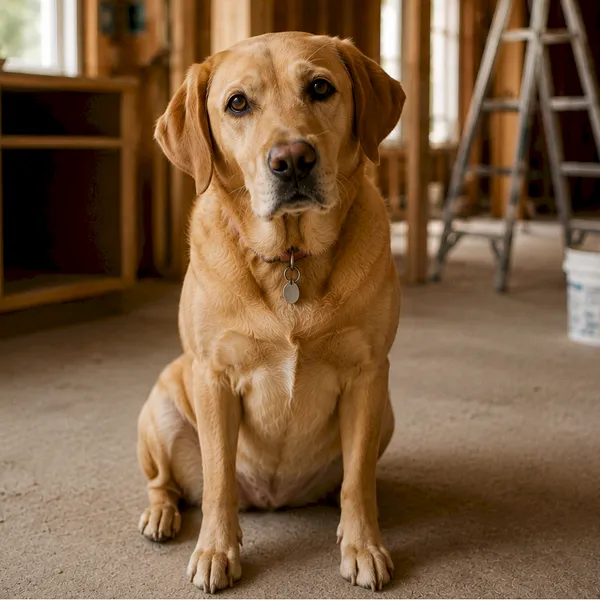
Brownie
Quality Control
Attends most client meetings. Has never once told a homeowner their project was hopeless.
She is a golden labrador. She is very good.
If any of this sounds like the kind of firm you'd want to work with, we'd like to hear from you.
Or read the rescue guide first.
The platform that started it all My Design Build Project